Showing posts with label believer. Show all posts

Tuesday, February 2, 2010

Prologue

[golden pen]Image by rhino neal via Flickr

Anteaters, the book *is* coming along. I went and looked at just how much this morning, and I'm encouraged once again that writing a book is a task I can accomplish. Especially now that we've settled into more of a routine.

I am going to need to pull back on a few things. As fun as they are, I'm probably only going to do one more Messin' with Mormons for the next few months, and I'm going to put a hiatus on counter-apologetics, too. I'll finish up the "E" from woman's role in the home, but I don't know how soon I'll move onto any others.

I think I needed the time to heal my head up a bit. I seem to be doing better now that I've gone back off the meds so fuck it. I'm not gonna kill myself trying to get a doctor to see me only to have to go on and then off meds again, due to a shitty insurance situation. (I got dropped from Medicaid for honestly reporting my unemployment earnings. Apparently in Florida, if your income is above $250/month, you do not qualify.)

So in the spirit of getting back into the book, here's the prologue I wrote a while ago.

Reblog this post [with Zemanta]

Read more!

Wednesday, December 30, 2009

Irrational Responder (VID)

I, Angie Jackson, do solemnly swear to do my best to get an actually written post on this blog within the next 48 hours. Till then, enjoy my first video counter-apologetic :D


Isn't the internet amazing?

Read more!

Tuesday, October 6, 2009

Turning Points

I've spent a lot of time wondering about my grandmother's cult in the past two years. Questions like, Why didn't more people speak out against what she was doing? and How did the world dodge the bullet by her cult staying small and eventually collapsing? And I think I have some answers. I'm convinced that my freshman year of high school was the most crucial year for the cult's eventual future. Several things happened that year.

I had run the cult office over the summer (while carrying on a dramatic and maudlin relationship with a boy in the trailer park), but when I went back to school she hired on various "friends". These were followers who had sold everything that had - houses and farms in Ohio and Montana - to come live in the same trailer park my grandmother did. Looking back, I see that year of people moving here as a potential beginning to a "true cult" compound.

Giggy had hosted a Healing in Zion seminar in the clubhouse of the trailer park, and people had flown or driven in from all over the country to hear her speak. I supervised their 40 children over that three day weekend (largely by assigning the older sisters to watch their younger siblings, which they did at home) and even put together a little song and dance with the kids, set to the hymn my grandmother used to rock me to sleep with, "Peace, peace".

Then I started high school, at a school for the performing arts. I made friends with Wicaans and lesbians, and I started to hope that some of Gig's exclusivity claims weren't true. I didn't want my friends to burn in hell forever! Then Harrison died, and the news made the national press. A few of the cult experts my mom and I have talked to this past year point to Harrison's death as one of the first major blows to Gig's credibility. And while she may not think she was involved now, in her dementia, the facts on the matter are clear. Gig was present when Harrison was stung - he actually fell in a yellow jackets nest in the backyard of her friend's trailer, which helped the new main office of the cult .

My mom told me yesterday she spoke with my unfriending aunt Z. Back when Harrison died (and later when Samuel and Jeremiah died), Aunt Z still had the same last name as my grandmother, and so friends and coworkers would ask, "Are you related to Carol?" So while she distanced herself - always - from Gig's practices and beliefs, she is still the one most willing to blame Gig's actions on mental illness. (I don't doubt for one minute that my grandmother was mentally ill. I've thought that since the first time I read the DSM-IV description for OCD, when I was diagnosed myself. But mental illness doesn't excuse killing children.

My grandmother was a pro-life baby killer. I don't think the press from that story warned away potential future converts. I do think it gave my grandmother pause. She never seemed to reconsider her views for the remaining years the cult was active, but she was also less bold in her pronouncements and her recruiting after that. She didn't want to garner negative press anymore.

Throughout her life, my grandmother has been in Redbook, Reader's Digest, and Time Magazine. She was on Jeopardy and three other game shows. Her near-death experience of driving into a canal in her fiance's car at 19 made national press, and her African-American rescuer even appeared on one of the game shows with her. (I don't remember the name of the program, but one person would answer questions to win prizes for another person, so my smart and witty grandmother stood in the spotlight, and won a washer/dryer and other fabulous prizes for the man she told us all her descendants owe our lives to. It's a shame she never told us his name, but I have the feeling she doesn't know it.)

He dove into the water to get her, after three white construction workers wouldn't - three workers who had seen her fall into the water, whose truck she had been trying to avoid when she went around them and off the bridge. (This was before there were guard rails on bridges, on the tiny blue highways in the center of Florida.) He was a trucker, and he dove into the water to save her. He swam down to her car, and wrenched open the door. But the pressure of the water pouring in was so great, that he couldn't keep it open, and the door closed on his right hand, across pinky, ring, and middle fingers. He struggled to get free, and eventually wrenched his hand away so he could swim up for air, leaving his fingers behind.

He swum to the surface, yelled for his son who was still in the truck to throw him a tire iron, and then dove down once again to save her. And as glad as I am that I'm here, and that my son is here, and that I'm alive, I wonder if the world would have been a better place if he'd left her there, as callously as the white men who contributed to her fall.


Today's image comes from MilebyMile.com, a highway website. Now imagine that little metal railing is gone, and you'll understand how she drove straight off the road, while attempting to go around a parked truck in the right lane, on an unlit road at night. There was no breakdown lane to speak of - just water.

Read more!

Friday, October 2, 2009

Crazy in Church

Scrupulosity is a particular form of Obsessive Compulsive Disorder (OCD) that focuses on religion and spirituality. I have OCD, and when I was younger and religious, I used to have irrational fears of future sins that I might commit against my will. (Kind of like my current irrational fear that I'll become a cult leader against my will.) Because of my family's religious practices (faith healing) I didn't get my OCD diagnosis until I had a spectacular nervous breakdown in front of 300 fellow algebra students at age 21, but that's another story for another time.

Scrupulosity was the one of my many mental afflictions that earned me the most praise. (If you don't think having OCD has been an asset at more than one job, you're crazy.) Because we as a society think that faith is a virtue, our moderate religious members don't seem to know what to say to people who exhibit extreme faith. If I'd stayed a believer, even as I got help for other disorders, I think the scrupulosity would have gone unchecked. Most of the therapists and psychiatrists I've seen over the years were Christian, and few people think religious devotion is a problem. (Atheists, you were right. It *is* a problem!)

One of the greatest harms of religion is its ability to inhibit mental health services for those who need them, based on its position of influence and authority. While my family's complete abstinence from medicine was extreme, many denominations and congregations teach against the use and/or effectiveness of psychiatric medications and cognitive therapy. Since, for certain conditions, such as bipolar disorder, this is the only treatment protocol that really works, it's a big deal.

2% of Americans have OCD, ranging from mild (maybe running back to check if the stove is on, two or three times in a day) to severe (Howard Hughes). I'm somewhere in between, but closer to Howie. 7% of Americans will have moderate to clinical depression at some point after age 18; 1 in 8 adolescents will suffer from moderate to clinical depression.

In a given year, 26.4% (just over 1 in 4, or 57.7 million) Americans will have a diagnosable mental illness. Of those, 45% will meet the criteria for two or more distinct mental illnesses (like me) "with severity strongly related to comorbidity." (In other words, if you have depression and anorexia, each one is likely to be more severe than is typical for people only showing one of these disorders. I've had both. Plus OCD, PTSD, and generalized anxiety disorder. I rarely leave the house these days.)

What these figures show is how prevalent mental illness is in our society. (So we need to quit acting shamefaced about it and just say - "Yes, I have this problem. Let's find ways of fixing it and/or dealing with it, instead of pretending it's not real.") About 80% of Americans are Christian, which means that even if every non-Christian was included in that 26.6% with psychiatric conditions, at least some Christians have gotta be crazy.

That's why it's so dangerous when churches mock science and keep their flocks ignorant, or conflate mental illness with demonic possession, and give an already vulnerable person more reason to put off getting treatment. When churches and church leadership suggest that prayer is preferable to psychiatric help, or that listening to the voices in your head is a good thing, they risk creating another Timothy McVeigh or Scott Roeder or Roland Robideux. Crazy people do crazy things - that's why sometimes we get locked up, and sometimes we get medicated. (The demon exorcisms, on the other hand, were NOT helpful.)

I've always been crazy, but I didn't know there was a name for what was going on in my head. Getting my diagnosis was this strangely empowering moment. Now that I knew what the problem was, I could start to actually deal with it. Early treatments were spectacular failures - Prozac made me hallucinate and think that I was melting, on campus - but it's better than doing nothing and infinitely better than trying to "cast out" my craziness through loud, authoritative prayer.

I think that we in the skeptical, secular humanist, ethical community need to start talking more about mental health issues, and we need to call what churches do abuse. I don't just mean exorcisms, although my personal experience with them brings gang rape to mind. When the church says that the voice in your head is real and is someone else, a demon or a god or the holy spirit, people who have problem voices *put off getting help, or try to get the wrong kind of help. When the church says that God gives comfort, people wait a lot longer - sometimes forever - to talk to someone about the incredible well of sadness inside them.

Mental illness is not "spiritual". It is largely the result of genetics, trauma, and chemical imbalance. It is not the fault of the afflicted person; it is not a generational curse brought down through the family line; and it is not rare. More than 1 in 4 Americans will have a mental illness at some time. That may mean periodic reoccurring bouts of bulimia, a single episode of severe depression, or a few months in intensive therapy dealing with PTSD, but it does mean that someone you know is likely to be affected.

If people get help, they're significantly less likely to commit suicide. Since this is the one shot at life people have, I would hope they'd get a long, good run out of it. I hate to see anyone cut their time short, for lack of simply knowing someone cared or lack of the ability to calm and comfort oneself. A person who gets mental health services is also less likely to hurt someone else.

I used to work typing up reports for a psychiatrist who did SSI disability determination, so the people in his office usually had pretty severe problems. Without fail - every. single. person. who talked about hearing voices in their head said the exact. same. thing. "They tell me to do bad things." No one ever goes to a psychiatrist for a voice that tells them to pet kittens. No, it's the person hearing a voice telling them to do "bad things" that we need to get help for - soon.

Here's a link to the 1.5 hour long Atheist Experience episode on Religion and Mental Health. (Skip ahead to 12:05 to bypass the several years out-of-date announcements.)

* All facts and figures are from the National Institute of Mental Health.

Read more!

Thursday, September 3, 2009

Prayer Bugs Me

My mother never pried. She had faults as a mother, but invasion of privacy was never one of them. She knew the importance of private thoughts. While I think her unwillingness to pry into my feelings left her unaware of the pain and mental confusion I was in for a long time, I have to say I value and respect the choice she made to let me be my own person, with my own thoughts and feelings. I could leave my diary open on the coffee table and know that she'd never read it.

Yet, I always felt better writing outside of the house, somewhere secret and quasi-magical. It was down by the blackberry patch at the creek when I was a small child, then onto a copse of trees beside a frozen golf course waterfall at the first place in Iowa, and either in a tree at the edge of a cornfield or on top of a wall holding back a hill from a parking lot at the second place in Iowa. When we first moved back to Florida, in to the apartments, I would sit beneath the willow tree on the bank of the man-made lake; once we moved into the house in the suburbs, I sat at on the dock at the riverfront park down the road.

So it shouldn't have surprised me, at 20 years old and living in my own place, that I still might feel the need to leave to write in peace. I remember crying, gasping in big tantruming toddler gulps of air, sobbing out loud to Jesus. "They say you won't give me more than I handle, but I'm telling you, I can't handle this! It's too hard. It never gets any easier and it never gets any better. Every time I think it's gonna get better, it just gets worse, and I'm tired of fighting all the damn time!" At the time, I was crying about money and how there just didn't seem to be enough of it. At other times, I cried nearly the exact same script, at the end of my rope, utterly desperate, crying heavenward and begging for mercy. Sometimes things would seem to get a little bit better following one of these break downs, but I didn't seem to be getting spiritual fruit or reaping any benefit for the trials I was going through. I was under the impression that when God tested you, when He gave you all that you could handle, when you survived it, you were rewarded for remaining faithful. Wasn't that the whole point of Job?

I feel sad and betrayed when I look back on those times. I knew that I needed help to carry life's burdens, but because I thought God was going to do that - and when there were only one set of footprints in the sand, that meant He was carrying me - I didn't look hard enough at the resources around me. Two weeks later, one night instead of calling on God, I called the suicide hotline. I'm typing this today because that was the right choice. It would still be another year till I got my first mental health diagnosis, and another five years till I found the right combination of diet, exercise, sleep, and medication, but it was a start. I was beginning to deal with my problems, instead of waiting on God to fix my breakfast.

Because God was nothing more than a voice in a head, He could never offer any comfort I wasn't capable of giving myself, or any insight I was incapable of having. Reliance on God, in mental and emotional anguish as in all things, caused me more pain. When I depend on God, when I say "It's all in His hands", I stop taking positive actions in my own life.

I would have gotten a therapist, a diagnosis, and medication sooner if I hadn't been raised in a faith healing cult, certainly. But I think I would have got them sooner still if I hadn't been raised a believer. I hate prayer now. It actively infuriates me when people bow before an imaginary construct, grovel and beg NOTHING, to fix their problems instead of working to fix them themselves.

I still struggle with money and I still struggle with a list of mental disorders. I am still crazy. But I don't have to beg any god to make me sane now - I can take medications, make alterations to my lifestyle, avoid certain foods. I can manage my life without a higher power. Believing in one hindered my drive for self-sufficiency and kept me dependent and child-like long past the time the world expected me to behave as an adult.

Read more!

Tuesday, September 1, 2009

Roles: Part One


I was the perfectionist who never tried. My grandmother had almost Calvinistically predestined roles for each family member to fill; my aunt Sally was the "sick one" she could baby; my mom was the "dependable one" she could manipulate and exploit; my brother was the "disobedient one" she could take out her anger on; my sister was the "good one" she could show off as an example of her superior parenting; and I was mini-Gig.

It was fairly easy to see the damage she was doing to my brother David. He acted out in his misery and anger, and go kicked out of multiple schools for bringing weapons and building bombs. He would fight me physically sometimes, and I would lose pathetically. But at other times, he defended me from neighborhood bullies and, in his scapegoat family role, he took a lot of the abuse from Gig away from the rest of us.

Likewise, my sister Esther was clearly affected. She was an obvious people pleaser at a very young age, and I remember her crying and screaming the day she got a "B" on her report card in second grade. She vowed to never get another "B" again. She didn't. But for the matter of an odd weighting system, my sister would have been valedictorian of her high school (instead she was a straight A salutatorian). My mom saw my sister's perfectionist tendencies and recognized them as a burden she dealt with also. I think she was able to directly refute some of the messages Gig was giving my sister, and I think it probably helped.

I was the perfectionist who never tried. I was supposed to be supernaturally good like Esther, supernaturally smart like David (who was already fixing home appliances and electronics in elementary school), and be supernaturally spiritual like Gig. As a child I always felt this tremendous pressure, not to live up to my siblings, but to live up to all the adults in my life. I felt like I had accomplished nothing in my ten years on earth because I couldn't contemplate ever being as successful (or more successful) than them. So I didn't try. I could never be as good as Esther, and frankly, the effort to reward ratio looked pretty crappy. Esther didn't get grounded and spanked as often as I did, but she spent hours doing chores or making other people happy, while I largely watched TV and played in the backyard between punishments.

My Christian teen years, I felt so isolated from the other youth group members. None of them had sex, or at least not as young as I did. None of them did drugs, or at least not as often as I did. At the time they looked like prep school elitists to me - there was no way trailer park Angie would be good enough for them. So I found ways to make people like me without being good enough. I was never the friend with a lot of cash to spend in high school, but I had a car and I had big ideas. I could find something for us to do, even if it was just playing "Soup!" and confusing all the pedestrians. But like with my own family and my sister, I felt I could never impress God with my goodness, because there would always be people who wore holier, sweeter, kinder than I was, or else more maternal or domestic or womanly, or more obedient, devoted, and reverent. I was loud, sometimes extremely socially awkward, with undiagnosed mental problems, and a lot of drug use. There's no way I could get on God's good side based on my behavior compared to the ideal of Christian youth I'd been presented with for years by Focus on the Family Brio! subscriptions (the vapid and vacuous teen girl magazine).

The "Ask Holly" section never included real pertinent questions like, "Am I still a good friend if I narc on someone who looks like they might have ODed?" or "My period is two weeks late - what do I do?" The questions were always so theologically simple I could have recited responses in my sleep. "My brother is a jerk sometimes, but I know God wants us to love everyone. How can we get along?" I doubt the girl who wrote that long-ago letter (or more likely the Dobson intern who did) had a brother who karate kicked her in the head or threw her into coffee tables. If she did, then the crappy advice about praying, submitting, and talking things over with her parents probably didn't do her any good.

For all that I was "sinning" my ass off, I voluntarily went to church each week and my mom was largely willing to go with denial as her choice response to my actions.
Because my rebellion appeared contained, unlike my brother's sometimes frightening pain, and because I didn't show signs of overt people pleasing, my mom believed that the close relationship I had with Gig was beneficial. But rebellious and obedient - the two roles my siblings had been assigned - were both obvious when manifested. I spent years desperately trying to figure out what my family assignment was, and finally deduced that I was chosen to be spiritual. Since being spiritual didn't involve being good, for Gig or for me, I didn't have to follow rules. I didn't have to get good grades - I wasn't the smart one. I didn't have to dress the way she likd - I wasn't the pretty one. I figured out exactly how much was required fo me, did that as perfectly as I could, and didn't even try anything outside that scope.

So I became as spiritual as I could, which really means that I believed in as many fairy tales as I could, with the most intensity I could. I believed that demons were at warfare with Christians and that I had been chosen by Gig and God to do battle against them. I believed that I had the power to heal people through my laying of hands and my words of prayer. I thought that if I could just say the right phrase, or the right trigger word, I could get God to move in amazing ways in my life. I spent hours, smoking joints and reading the Bible, trying to get as close to God, as close to Gig, as possible.

Read more!

Friday, August 28, 2009

Cults Can Be Funny

Today I wanna talk about one of my favorite topics - Cults. Now I know most of you probably have hobbies that are entertaining, or physically exhausting, or mentally stimulating. I have a hobby that's suicidally depressing. But important.

One way I deal with the the compassion fatigue or emotional overload that comes from reading tol many cult survivor stories in one sitting is with the lulz. This video, while being totally instructive and accurate, cracks me up in a dark humor kind of way. (I still think Angela's Ashes is funny and has a happy ending. My family saw the movie based on my impression, and now they think I'm twisted and weird.) So, with that kind of a endorsement, watch and enjoy!


I may have posted that before - I don't care. It's a good video. Seriously, of all the cult checklists and papers and testimonies I've read, this is the best, simplest Cult 101 explanation I've seen. I showed this video to a Christian cult escapee who was staying with me for a while this summer. I was trying to let her know that what happened to her happens to lots, yadda yadda. I think it just freaked her out that I know how to start a cult.

But really, starting your own cult is easy. Just look at the five simple steps in this eHow article. (I don't know if it will happen for you also, but when I pulled up that page a giant flash $cientology ad came up under the checklist, lol.)

Phil Milstein has a more thorough (and delightfully snarky) six steps in his piece "How to Become a Cult Guru or, You Too Can Induce Mass Suicide." Some pearls of wisdom from it include:
Remember that everyone you meet is, deep inside, like a scrawny branch wavering in the stiff wind of life, just waiting for a big tree to sprout up alongside and protect them. Be that tree...
And on why laundromats are an awesome place to collect new recruits:
Down at the local suds parlor you'll find oodles of brain-dead scum, just sitting around twiddling their thumbs and spitting pumpkin seeds. Perfect cult fodder.

Heartwarming, no? Although I'm pretty sure around here sunflower seeds are a lot more popular than pumpkin, I'm sure the principle still applies.

This post that made me wanna ROFL or at least PMP (pee my pants - come on people, it could catch on). It's 5 steps to starting your own $cientology off shoot denomination.

So remember folks, whatever your cause or passion is, while it's important to stay dedicated towards positive actions and efforts, and while promotion awareness and legislation and social protests (I mean marches dumbass - leave your assault rifle in the armory at home), it's okay to laugh, too. I know cults are awful. I know good people do terrible things and have terrible things done to them. But laughing can be a really effective coping mechanism, and it's served me well through many trials and tragedies, so I'm gonna keeping LOLing over here, even about the serious stuff like cults, and I'd love it if you joined me in the merry making.

Read more!

Thursday, August 27, 2009

Seek and Ye Shall Find

I was six years old and I really, really had to pee. My sister and I used to ride our bikes to the church about a half mile away from home, to sit on top of the big brick sign and eat kumquats stolen from a neighbor's tree and smuggled in our handle bar fanny packs.

I told my sister about my need, and we walked up the church to use their bathroom. The door was locked. I started to sing, and Esther joined in with me. "Knock and the door shall be opened unto you, Alleluia." We walked all around the church, singing this and trying out different doors, knocking (and trying very hard to hold it). Finally, as we circled back around to the front, a red-headed boy only a year or so older than I stuck his head out the front door and demanded, "What the heck you singing for?" I told him that I was praying, because I needed a bathroom so I could pee, and I didn't think I could hold it to bike all the way home.

He slammed the door close. My sister and I got our bikes and headed home, where I was finally able to relieve myself. I don't know what the story never bugged me as a kid - either that I was so deluded (and impractical because clearly I was able to make it all the way home and walking around singing took valuable time), or that God so clearly did not keep his end of the bargain. I mean, if you believe in the God who has a covenant with mankind and has made certain promises (and is omnibenevolent, sinless, perfect, and never lies or makes mistakes) shouldn't it bug you when he doesn't actually move mountains in response to your faith?

On a side note, I had a card of this picture of Jesus knocking on "the door of our hearts" (ventricles?) when I was a little girl and I remember sitting in my room, staring at this picture for hours, feeling so much love for Jesus. My parents never told me about Santa Clause, because my grandmother didn't want anyone else getting credit and because my mom didn't want to lie to us. But I think I can relate to how the kid must feel when he learns that Santa isn't real.

Read more!

Friday, August 14, 2009

Thanks, Teacher

I was really upset about evolution. I liked Miss Tyner. After Miss Kinney in 7th grade (evil, horrid troll who decided to tell us during sex ed that she was a 72-year-old virgin), I didn't think it would be possible for me to like another science teacher. It was my least favorite subject, but Miss Tyner still managed to be one of my favorite teachers. She was young and beautiful and funny. She had long, slightly frizzed curly hair, and she used to sit cross-legged on top of her desk, with her Birkenstocks kicked off on the floor.

Miss Tyner would sometimes take my Freshman biology class down three flights of steps to the river that wound by the school property. Her appreciation for nature appealed to the environmentalist in me. Since 4th grade I'd been engaged in environmental thinking, also due to the influence of a rather fantastic teacher. Miss Price led us in letter-writing to "GLOP" (global leader in over packaging) award recipients, such as Starkist for their tuna lunch product (plastic container for everything, a separate wrapper for the crackers, a little tin of tuna, individual condiment packets, and a tiny disposable wooden spoon).

So I was disappointed in Miss Tyner for telling me that Darwin was right, and that all species shared a common ancestor. I didn't really understand evolution or what she was saying about natural selection, but I knew how the world was created and how god made man, and evolution wasn't in the cards. The day we started the Evolution chapter of the text book she started with a ten-minute introduction before getting into the material.

"The theory of evolution by natural selection is the most widely accepted scientific theory for the origin of our species. No other theory even comes close to be accepted as factually supported by evidence. This is a science classroom, not a religion class and not a church. I don't want to insult or offend any of you, but this is the material you'll need to know on the test. If you'd like to express your concerns in private after class, I'd be more than happy to do so."

I did talk to her after class that day and I told her, "You shouldn't teach this is as a fact. It's only a theory. If you just said you weren't sure that it was true, that would be okay." I'm sure that at that moment she tried to explain the difference between a theory in most casual conversational senses and a scientific theory. Sadly, I was pretty dogmatically opposed to the concept of science in general and to evolution in specific.

"Angie," she finally sighed. "You don't have to believe that evolution really happened. You can disagree with the subject material, but this is what I'm teaching and this is what the school district and I both want to test my students on. You don't have to believe it, but you need to know it for the test." Somehow, this answer worked for me. In a sense, it gave me permission to learn the facts, even if I only accepted them as a very tenuous, unsupported "theory". (Oh the arrogance of religiously brainwashed youth!)

I'm so grateful, Miss Tyner, that you taught me the truth. I'm thankful that you were kind and you explained your reasons, but you didn't back down and let nonsense or debate dilute the science. Nothing you said was offensive, nor did it give the false impression that evolution was equivalent with any other crackpot idea someone might have. While I still doubted the existence of fossils, and thought God must have some purpose in his design when he thought up vestigial organs and tails, facts were able to penetrate. I began to accept natural selection, at the least. Those often-scorned peppermoths made complete sense to me. The further knowledge that outside pressures like pollution and predators don't cause the genetic variance in the first place, and merely show its usefulness to a species came later.

I was a creationist for 25 years. I passed high school biology while still believing that all humans shared two common ancestors named Adam and Eve, despite the obvious genetic diversity among people on this planet. I bought a car, signed a lease, got married, and had a baby all while still believing in fairy tale nonsense that huge portions within the religious community recognize are completely ridiculous. I'd glad to be on the other side now.

Now I think science is really beautiful, and intellectually honest and kind of noble. After growing up in a cult where we just weren't *allowed* to test claims or doubt the words of the Bible or our leader, science is just very, very soothing. It's so nice to know that there are people who care more about finding the truth than being seen as right. And I'm glad I had one of those people for a teacher.

Here are some of my favorite resources for explaining evolution and answering questions about it.

What Evolution Is and What it Isn't
Talk Origins

Finally, this video from Impaler 1815 is concise and easy for just about anyone to understand. I also recommend his video on transitional forms.


I'll be doing a related post later in the week specifically on science resources for kids, and resources on how to introduce science to your nieces and nephews growing up in creationist homes.

Read more!

Tuesday, August 4, 2009

100 Questions: Update


Come on party people - throw your hands in the air! Sorry, I had a moment. Uh, let's see - today is Tuesday and I'm going to keep doing Tuesday updates on our 100 Questions for Christians till we hit that number. (And maybe beyond - we'll see if I'm bored then.)

Neece at Heaving Dead Cats has been having her minions (or "readers" if you're all super sensitive about it) comment to add questions to this list also. As Angie the Anti-Theist I reserve the right to decide which questions *I* like the best, and add them to the list. So be creative, inventive, and come up with something new! Here's the list we have so far:
  1. If homosexuality is a sin, are gay dolphins sinning?
  2. Will there be jello molds with marshmallows in them in heaven? Explain.
  3. Which is a bigger sin, passing out drunk and naked to be either seen by and/or sexed by your kids OR walking in on your dad while he's passed out drunk and naked, and see the twigs and berries?
  4. What Would Jesus Do?
  5. If god is better than we are, how come we can think up unicorns but he can’t make them?
  6. Same with mermaids.
  7. Did Jesus have acne as a teenager? Please explain.
  8. Why is the Brick Testament the best version of the bible?
  9. Why is christian music so painfully square?
  10. Is it better to be right or popular?
  11. Should god be put on trial for crimes against humanity?
  12. What are some contradictions in the Bible? Please list no fewer than 3. (or was it 5?)


  13. Why waste Jesus' meager 3 miracle years on earth with petty tricks like turning water to wine and cursing a fig tree?
  14. Why didn't Jesus write any of his own material?
  15. What does God have against pillows?
  16. Why is god dependent on human translation efforts to spread his message?
  17. Will we have sex in heaven?

  18. Will we masturbate in heaven?
  19. Will we have competitive eating contests in heaven?
  20. How many people do you personally know that you think god is sending to hell?
  21. Doesn't that just suck?
  22. Will we learn new things, write new stories, sing new songs in heaven?
  23. How the heck do you know what heaven's gonna be like? You've never been there!
  24. Do teenage Jesus wake up with a boner every morning? (Sent in from a Christian reader - thanks!)
  25. Why do you think we have rainbows? (Please say Noah, please say Noah)
  26. Are you pracitcing another religion - going a-whoring - if you do yoga? Meditate? Decorate with feng shui?
  27. Have you ever talked back to your parents, or have your kids ever talked back to you? Then this next point might upset you...

That's all I have so far, which means I need you to keep submitting the funny. Solicit the help of your friends and coworkers (unless you work as a church secretary - then it's probably a good idea to keep this site cleared from your browser history). Send everyone on over to Stump the Fundy with 100 questions for Christians.


Read more!

Saturday, July 25, 2009

With Friends Like This...


Well, there seems to be a new one every week, a Christian who claims atheism is a kind of faith. So let's parse this nonsense and explain again the chasm of distinction between belief and non-belief. (You'd think it would be so obvious they aren't the same thing, but you'd be surprised.)

Irish Times Op-Ed writer Breda O'Brien claims
Atheists often appeal to science to underwrite their disbelief, but the decision not to believe in God lies ultimately in the arena of gut feeling, or hunch, or intuition. That decision is something that the scientific method cannot arbitrate on.
Oh, I see. So it's just a "gut feeling". Well, that is a good description of faith - an ultimately emotionally driven institution. When I believed I did so because I'd been indoctrinated as a child, and then later on as a young adult, because I desperately wanted it to be true. There was no evidence, no proof, no real good logical defense for my belief. I just felt it; I felt such certainty I thought I knew it was true, although if you'd asked me why I'd have been pressed to defend my belief. I probably would've have said it was a matter of faith, if forced to have such a conversation at all. I certainly would not have presumed to understand atheism.

The author goes on to assert that
The decision to live as if there isn’t a god requires a leap of faith, as does the decision to live as if there is. Religious people and atheists have a great deal in common. And now that Irish atheists are banding together, planning good works and hoping to influence Irish society, it looks more and more like a religion.
Because after all, sleeping in on Sunday morning requires so much investment! Seriously though, saying "I don't know, but there's no real evidence" doesn't require faith. Saying, "I know there's a God, and I know what he wants, and he wants me to worship him"? That requires faith. Undoubtedly. Can you see how those are not truly equivalent though? Stating a positive claim ("There is a god") asserts that something is true. And, as Tracy often says on The Atheist Experience, "Things which exist manifest in reality." Since there are NO manifestations of a supernatural all-powerful deity in our reality (zip, zero, zilch, nada, nein, none), disbelief seems only rational. It is not the same as asserting the positive claim "There is NO god". Lack of evidence is not necessarily evidence of lack. But I have to say it seems more likely to me.

That said, although I blog about it regularly here and on Atheist Nexus, I'm not so invested in my atheism I'd be unwilling to chance my stance. If I was presented with sufficient evidence, I would discontinue my disbelief, and have to accept the existence of whatever deity was proven. (Whether or not I'd worship a god would be entirely dependent on the character, attributes, and actions of said deity.) It is rather rich of the author to try to hijack secular good works as making atheism "more and more like religion". That might be a more valid argument to make if atheists were say, depriving their children of medical care or killing them for demon possession. Those actions really are more and more like religion.

Our author now claims to have many atheist friends. This gives me de ja vu thinking of racists who always preface their comments with, "One of my best friends is black!" In quoting an atheist friend, the author misrepresents Richard Dawkins by suggesting
Dawkins takes the Bible as literally as any Protestant fundamentalist. The only point of disagreement is that Dawkins finds it unreliable about science, whereas fundamentalists do not.
This is categorically false. What Dawkins does do is illustrate through a literalist, non-apologist reading of the Bible (which is what your typical American non-theologically trained Christian will do) that if the character of Yawhew was real, He'd be a right immoral prick. The quote she is almost certainly referring to is from The God Delusion
The God of the Old Testament is arguably the most unpleasant character in all fiction: jealous and proud of it; a petty, unjust, unforgiving control-freak; a vindictive, bloodthirsty ethnic cleanser; a misogynistic, homophobic, racist, infanticidal, genocidal, filicidal, pestilential, megalomaniacal, sadomasochistic, capriciously malevolent bully.
And you know what? He's got a really valid point going on here. (See my comment above re: Even if a god exists, it might not be worthy of so abject a thing as worship.)

The author next claims new atheists don't care about the poor, human rights, or justice, and that we are instead content to blame everything that's wrong in the world on religion. (Join Atheist Nexus on Kiva, as the largest "religious group" micro-lender!) Finally, religious atrocities are brushed aside as nothing more than a "dark side" of this era, and in no way actually the responsibility of organized religion. As a closing (clumsy) shot the author quips
With apologies to Rodgers and Hammerstein’s Oklahoma !, the atheist and religious person can be friends.
Well yes, obviously. I don't know a single atheist who doesn't have at least some theist friends. In this country for instance, over 80% of the population claims to be a follower of some kind of faith. The question isn't whether or not atheists can be friends with religious people. The question should be, why on earth would they want to be friends with Breda O'Brien?

Read more!

Sunday, May 17, 2009


I watched Daniel Dennet's presentation at TED recently, and was struck when he mentioned that "Every time you read it or say it, you make another copy in your brain".

This can be very useful when studying. In college I would carry a single small notebook in my purse, and jot down practically every single word one of my professors would say. Once I got home, I'd recopy these notes into separate notebooks for each course. Each weekend, I'd review the notes for each course, and as exams approached, I'd go over them once again. For classes which required a lot of memorization of specific facts or definitions, I'd also make flash cards, and keep these in my back pocket to review while standing in line or between classes or at red lights in traffic. I made repeated copies of the information in my brain, so that I could recall it with ease in the high-pressure setting of an exam. I would know the right answers, because I had drilled myself on them so many times.

I got to thinking about what this meant in terms of religious practice. As a child, prayer was woven into the fabric of everyday life. We prayed over meals, in the mornings before traveling, and at night before going to bed. We went to church every week, at least once a week, and sang the same songs over and over every year. We made copy after copy after copy of these ideas in our brains. Perhaps this is exactly why so many religions emphasize the importance of daily devotions, bible studies, offices of prayer, and weekly church attendance. Each of these activities acts as a form of memorization, embedding the ideas more and more thoroughly into our minds, so that they occur to as the "right" answers, much as the notes I studied before exams.

I quit attending church services regularly after my son was born. For one thing, I was tired all the time. He was sickly as a young child, and I was nursing him, which was difficult when the church wanted me to leave him in the nursery, where he wouldn't be a distraction during the service. I also didn't fit very well in my "Sunday best" anymore with the addition of baby weight, and happened to break my ankle when my son was only a few weeks old. The combination left me at home a lot of Sunday mornings. As time went on and I could reasonably have begun attending services regularly again, I had begun to appreciate the heathen thrill of sleeping in, or lounging around in my pajamas, on a Sunday morning. I didn't quit attending church because I didn't believe in God, but as I failed to go to church, my belief waned. I'm not sure it would have been as easy for me to disbelieve as it was, if I'd been hearing the counter-message "God is true, God is real, God is here, God loves you, God cares inordinately about your sex life" every single weekend.

Many former believers I know talk about still having fears of hell, or dreams about church attendance, long after they leave their faith behind. I think this concept of "making another copy in your brain" may be the root of it. There are some things I learned in college I doubt I'll ever forget, like the principals involved in the "Corrupt Bargain of 1824" (when John Quincy Adams stole the election from Andrew Jackson). In the same way, I don't know that I'll ever forget the words and sign language to "Jesus Loves the Little Children" which I must have sung a thousand times in my early years of life. So when thoughts of God or Christian songs pop into my head, I don't need to give them any more credibility than the memories that they are. I was taught a myth as truth for over 20 years; it seems reasonable to believe, it may take some time before these ideas fade. In the meanwhile, I can study and drill and read and write over and over again the things I know ascertain to be true - the universe is a weird and wonderful place, no more designed for me than for the influenza virus. And I'm going to enjoy every guilt-free moment of the brief life I have in it.

Read more!

Sunday, May 10, 2009

If the Bible was True: A Case for Christian Fundamentalism

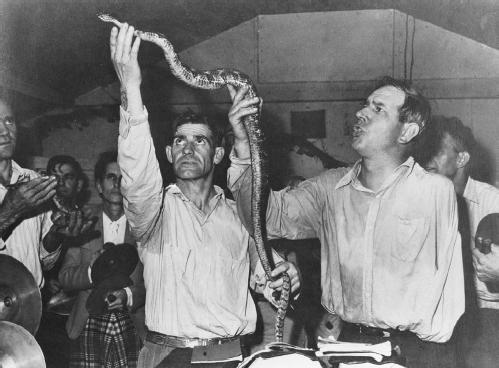
My family were true believing fundamentalists. In fact, we looked at churches like Saddleback and thought "Pff! They aren't TRUE Christians." Frankly, we didn't have much respect for people who didn't take their faith seriously enough to entertain the notion of drinking a little poison now and again or handling venomous snakes. I mean, come ON - the Bible says if you really have faith you can do it and not be harmed!

Christians and atheists all seem to agree on one thing: My childhood was wacky. Christians say it wasn't the "right" interpretation of scripture, and atheists say it's further evidence of the madness religious teaching can lead to. This reaction from Christians has always bothered me a bit.


See, I tried the whole mainline Christian thing for a few years. Churches where they let parents take their kids to doctors, or where women were allowed to speak, and no one wore funny clothes. My youth group invited Christian "hardcore" bands to play at the church, and my pastor and I actually had an outreach ministry to the dancers at a nude bar (he sat outside and talked with the bouncer while my mom and I went in to tell the ladies about God's love and grace). But the whole time I was being a "moderate" Christian, I was worried about that lukewarm verse, Revelations 3:16 "So because you are lukewarm, and neither hot nor cold, I will spit you out of my mouth." I worried that being a lukewarm believer was worse than rejecting God outright.

My grandmother (Carol Balizet, leader of Home In Zion Ministries cult) put a lot of focus on the promises Yaweh/Jesus made. If the Bible is the inerrant Word of God, if God only speaks truth, then the Bible is true. If the Bible is true, and God made these promises in the Bible, then the promises are true. (Yeah, I realize now exactly how many "IFs" are in there, but I was young and ignorant.) So what are some of these promises?

- If you have faith the size of a mustard seed, you can move a mountain by commanding it and "nothing will be impossible for you" (Matthew 17:20) (Also, a mulberry tree in Luke 17:6)
- You can stomp all over snakes and serpents and demons and "nothing will injure you" (Luke 10:19)
- You can handle venomous snakes and drink poison safely, and you can heal people through the laying of hands (Mark 16:18)
- Life and death are in the power of the tongue, of your words (Proverbs 18:21)
- If you believe in the biblical story and accept christ as your savior, you'll enjoy paradise in heaven (John 3:16)

These are the verses I lived the early years of my life by. Frankly I don't see the POINT of moderate religion. If all the IFs above are true, then why NOT live the crazy fundamentalist lifestyle? I mean really, he says you'll be known by your ability to handle snakes, drink poison, and heal people. Why *would* Christians go to doctors or lock their front doors? Why start a savings account, when God promises to provide for all your needs (Jehovah-Rapha, I will provide, somewhere in Deuteronomy I think)? Why live a balanced, reasonable life if you've got the ultimate Ace in Hole?

Now I've come to the conclusion that the IF statements above are all false - no god, no true bible, etc. But if they WERE true, why not have crazy faith? Why not TRY to move some mountains? How many Christians do you see trying to move mountains? Or fix the economic crisis? Or just pray away world hunger? No, they live small lives because they have a small god. And I have no use for a small god. Once I learned the hard way that the big God I grew up with was a myth my grandmother told me, I had no need for any kind of god at all. Who would anyone settle for something so paltry as the American Christian god?

Read more!